
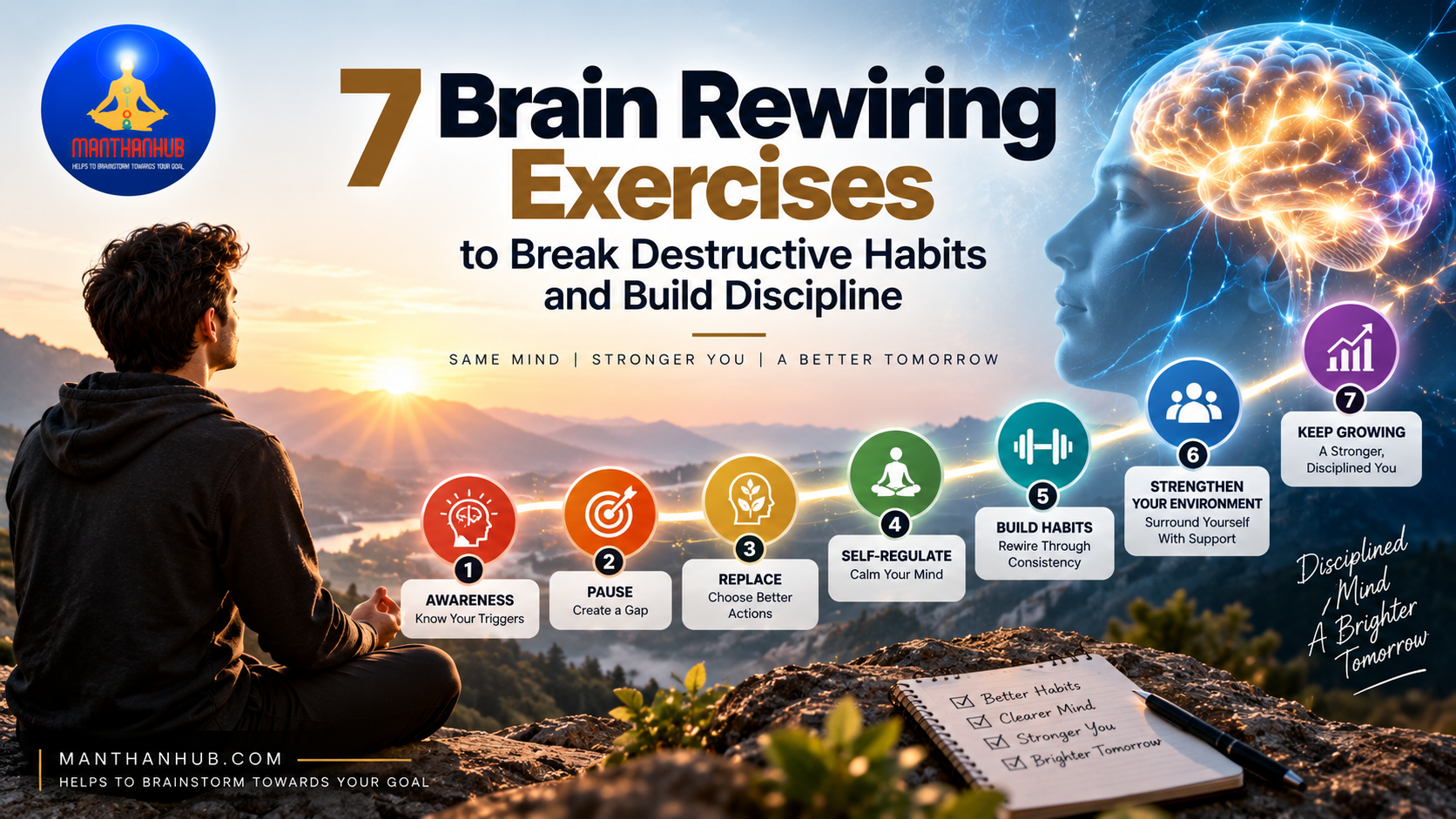
Breaking a destructive habit rarely comes down to knowing it’s harmful. Most people already know what they need to quit, but they repeat the patterns because the behaviours have become intertwined with attention, emotions, environment, routines, and instant gratification. Brain Rewiring Exercises can help you notice these patterns and rehearse healthier reactions.
Neuroplasticity refers to the brain’s ability to adapt through learning and practice. This does not imply that an exercise will immediately rewire the brain. Practice, reflection, and repetition of behaviour drive change. ManthanHub Brain Rewire by Radheshyam More frames this process through Attention, Repetition, Emotion, Energy, Environment, Identity, and Purpose.
The following practical exercises can help you detect destructive habits, build self-discipline, and slowly shape behaviour that helps you become the person you want to be.
How Brain Rewiring Exercises Support Behaviour Change
Brain rewiring exercises don’t aim to make you think positively all day. They help make automatic behaviour more noticeable and rehearse a different response.
Behaviour can become automatic when you practise it over a long period of time. A specific emotion, time of day, setting, or digital stimulus can trigger the same sequence. Real-life activities can help you stop that chain earlier.
Repetition Matters More Than Motivation
An incentive fluctuates day by day. Repetition creates consistency. That is why exercises that support neuroplasticity should be easy enough to do regularly.
You don’t have to change ten habits at once. A more effective approach is to find a single repeated pattern and practice one healthier response until it becomes more comfortable.
Awareness Comes Before Habit Rewiring
The best place to start when rewiring bad habits is to identify the real causes of the behaviour. Unless you understand which aspect of boredom, stress, loneliness, fatigue, digital stimulation, or a specific environment triggers the cycle, you may keep trying to address the wrong issue.
7 Brain Rewiring Exercises to Break Bad Habits
These brain rewiring exercises turn awareness into action. The exercises focus on various aspects of behavior change, such as attention, repetition, emotion, environment, identity and discipline.
You are not required to do all seven exercises on a single day. Begin with the practice related to your largest existing problem and work on it regularly before you add another.
1. The Attention Audit Exercise
What you pay attention to keeps coming into your mind. When you wake up and go to sleep with notifications, quick content, scrolling, and internet distractions, it becomes even harder to engage in focused behaviour.
For three days, record where your attention goes during unstructured moments. Record the apps you open by default, what distracts you during work, and the thoughts that keep pulling you off your main tasks.
At the end of every day, find your top three attention leaks.
And then make each a rule. For example, turn off unnecessary notifications, delete a distracting app, or leave your phone off-task during serious work.
This is one of the easiest brain exercises to rewire your brain because it changes what you focus your mental energy on.
2. The Trigger-to-Response Exercise
Habits can be triggered by common causes. Scrolling can be caused by stress. Compulsive entertainment may result from boredom. Isolation can result in bad online behaviour. Discipline can be undermined by fatigue.
Write down one habit you want to change and complete this sequence:
Trigger → Emotion → Automatic Behaviour → Consequence
For example:
Boredom → Restlessness → Endless scrolling → Lost time and frustration.
Now create a replacement:
Boredom → Restlessness → Ten-minute walk → Return to meaningful work
The aim is not to avoid all triggers. It is to rehearse a healthier reaction when the trigger appears.
This exercise can be used by individuals who have issues with compulsive pornography or masturbation problems as well as a formal PMO Recovery Program where treating triggers and recurring behavioural patterns becomes a significant aspect of the recovery process.
3. The Ten-Minute Delay Exercise
An urge can feel urgent because the mind wants something done at once. Creating space between an impulse and your reaction is one of the most effective self-discipline exercises.
As soon as an unhealthy desire comes up, tell yourself:
“I will wait ten minutes before making any decision.”
In ten minutes, transform your physical surroundings. Take a walk, drink water, perform some short exercises, or start another activity.
After ten minutes, reassess the urge.
You are not trying to show that all urges vanish entirely. You are conditioning yourself to understand that you don’t have to act on an impulse immediately.
Delaying again and again strengthens the habit of taking time to respond.
4. The Environment Reset Exercise
People often try to quit negative habits but keep the same surroundings that keep triggering them.
When your phone distracts you, leaving it next to you while you’re trying to concentrate creates unnecessary temptation. For late-night scrolling, it’s better to take the phone to bed and reinforce the habit every night.
Choose one destructive habit and ask:
What in my environment makes this behaviour easy?
Then modify your surroundings, not your willpower.
Eliminate distractions by deleting distracting apps, avoiding high-risk places, prepping a clean workspace, or making healthier options more accessible.
One of the most practical types of habit rewiring is environmental design since it minimizes the number of situations in which you are confronted with the same temptation over and over again.
5. The Identity Evidence Exercise
Human beings tend to define themselves by their shortcomings.
“I have no discipline.”
“I always procrastinate.”
“I cannot stay consistent.”
These statements can become part of your self-perception.
Rather, list the identity you desire to create.
For example:
“I am becoming someone who protects my focus.”
Then establish a behavioural result of that identity.
Note each time you accomplish a significant task, resist an unnecessary distraction, or stick to your exercise or routine.
At the end of the week, review the evidence.
This practice helps transform personal change from aspiration into identity. ManthanHub Brain Rewire Sessions can also be explored by readers in need of personalized accountability around habits, discipline, and consistency.
6. The Dopamine Discipline Exercise
Contemporary virtual spaces make instant gratification easy to obtain. The slower activities, like studying, reading, or deep work, can become less desirable due to short videos, endless feeds, gaming, entertainment, and notifications.
Select one time of the day when you will reduce unnecessary stimulation deliberately.
For example:
No short-form videos within the first hour of being awake.
No phone during meals.
During work, spend 30 minutes concentrating before entertainment.
One evening each week with minimal digital stimulation.
This does not imply that dopamine is bad per se. Dopamine is essential for learning and motivation. The practical aim is to decrease compulsive stimulation and practise delayed gratification.
Individuals with difficulties with continuous instant gratification can relate these exercises to the Dopamine Discipline Program to have a more systematized focus, digital habits, and self-control.
7. The Purpose Alignment Exercise
The best brain-rewiring exercises don’t focus on what you are trying to quit. They also concentrate on what you want to build.
Prepare a page and respond to the following questions:
What habit am I trying to leave behind?
What is this habit costing me?
What would improve if I changed it?
What type of person do I want to become?
What larger goal makes this change worth the effort?
Purpose gives discipline direction.
When motivation declines, someone who understands why they want greater focus, better health, better relationships, career development, or more control over themselves has a stronger reason to keep going.
That is why purpose is among the seven elements in the ManthanHub Brain Rewire framework.
How to Make Brain Rewiring Exercises More Effective
The exercises are only useful when practised regularly. Reading about behaviour change can build awareness, but putting it into practice generates evidence.
Start With One Exercise
Don’t try to reorganise your entire way of life in a week. Select the exercise that is related to your greatest problem.
- If distraction is the problem, start with the Attention Audit.
- If impulsive behaviour is the problem, practise the Ten-Minute Delay.
- If your environment creates repeated relapse, begin with the Environment Reset.
Track Progress Every Week
Develop a weekly self-review, rating yourself on:
- Attention
- Discipline
- Trigger awareness
- Digital habits
- Emotional control
- Consistency
- Purpose
It is not a goal to obtain high scores. It is to determine whether more consistent, healthier patterns are being found.
How ManthanHub Brain Rewire Supports Practical Transformation
ManthanHub Brain Rewire by Radheshyam More is built on the idea that lasting change needs more than inspiration. The book relates Attention, Repetition, Emotion, Energy, Environment, Identity and Purpose to practical reflection and activities.
The book provides a structured framework for understanding destructive patterns and developing healthier behaviour.
Individuals who need further instruction may attend Brain Rewire Sessions, and those with overstimulation issues can attend the Dopamine Discipline Program. Individuals whose destructive behaviours relate to pornography or compulsive PMO habits may be more associated with the PMO Recovery Program.
The idea is to select the level of support that fits the issue instead of trying to resolve all behaviours with one approach.
Conclusion
The best brain rewiring exercises are not tricks. They are repetitive exercises that help you become more aware of attention, triggers, impulses, the environment, identity, and purpose.
First, determine the behaviour you want to change. Research what causes it. Develop a healthier alternative. Reduce unnecessary temptation. Practise delaying impulses. Develop a stronger sense of self, and connect your discipline to something meaningful.
ManthanHub Brain Rewire offers a systematic approach to developing these concepts further using Attention, Repetition, Emotion, Energy, Environment, Identity and Purpose.
You need not reconstruct your whole life today.
Choose one pattern. Practise a more appropriate response. Repeat it consistently.
That’s when rewiring starts.
FAQs
What are brain rewiring exercises?
Brain rewiring exercises are practical exercises that help you become aware of recurring behavioural patterns and encourage healthier responses by paying attention, practising, changing your environment, and acting consistently.
How long do neuroplasticity exercises take to work?
No single time period exists. Behaviour change depends on habit, regular practice, setting, emotional factors, and consistency. Measure progress by behavioural improvement, not a set neurological time frame.
Can brain rewiring exercises help break bad habits?
They can support behaviour change by helping you identify triggers, disrupt automatic routines, rehearse alternative responses, and redesign environments that repeatedly reinforce unwanted habits.
Which exercise should I start with?
Start with the exercise that matches your biggest difficulty. Use an Attention Audit for distraction, Trigger-to-Response mapping for repeated habits, or the Ten-Minute Delay exercise for impulsive behaviour.
Is brain rewiring the same as positive thinking?
No. Positive thinking alone is not brain rewiring. Practical change requires repetition, learning, behavioural and environmental adaptations, emotional awareness, and practice.