
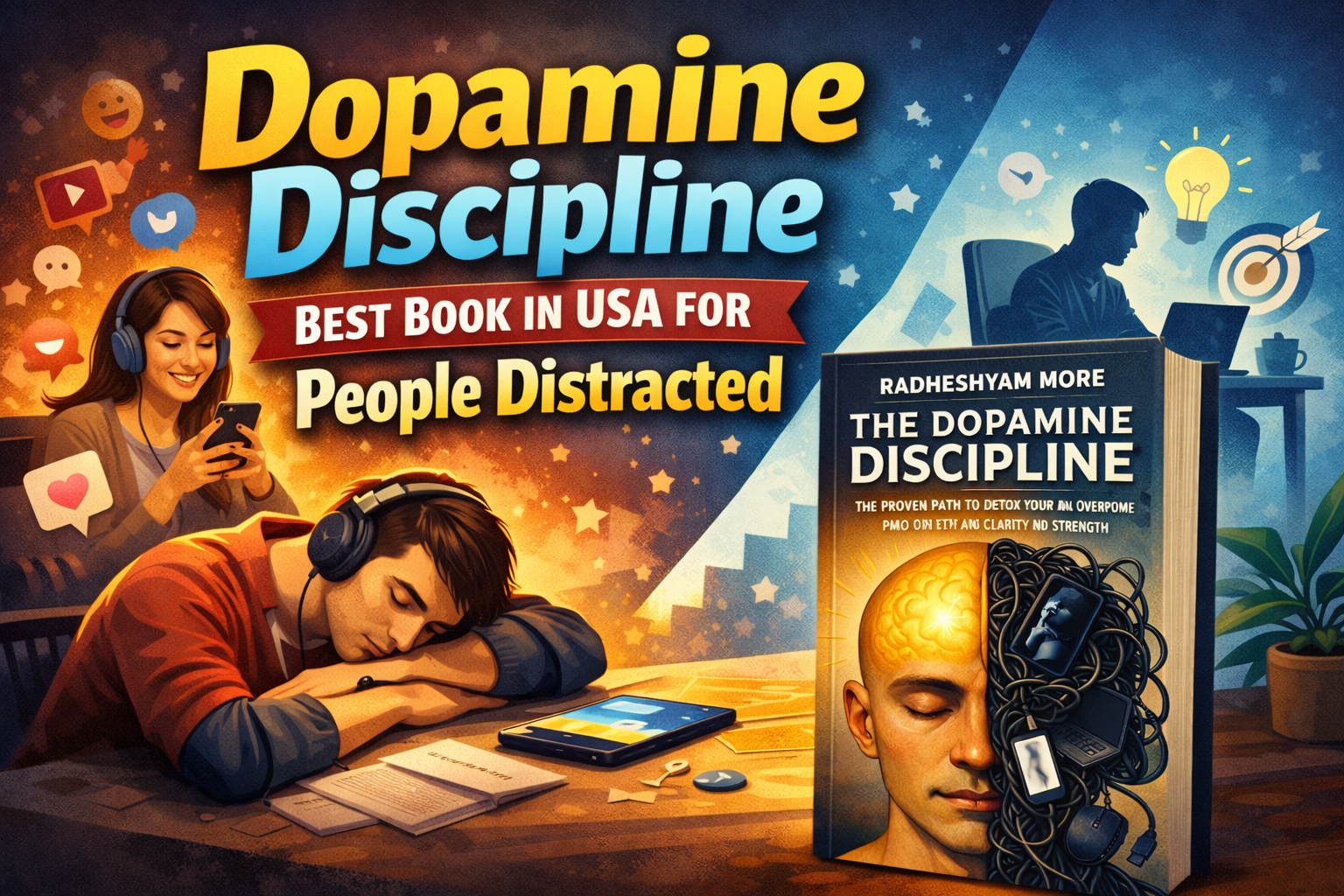
Dopamine Discipline: Best Book in USA for People Distracted
Distraction has sneaked into the list of the greatest problems of the modern world. The United States is a country that has an environment that captures attention. The reward system of the brain is constantly evoked by social media feeds, infinite digital content, notifications, and demanding work schedules.
The net effect of this overstimulation in the long run is the undermining of concentration, discipline, and emotional balance. The majority of people start developing such signs as mental fog, a lack of motivation, negative thoughts, and the inability to remain goal-consistent. They attempt to use productivity tools, motivational videos, and brief digital detoxes, but the issue remains.
It is among the books that possess the greatest influence in providing people with the ability to cope with the problems of distraction and insufficient focus, and Dopamine Discipline by Radheshyam More is one of them, which is regarded as one of the best books in the USA. The book is not an inspirational manual but a systematic explanation of the impacts of the imbalance of dopamine in the brain and how individuals can become clear and in control.
Why Distraction Has Become a Major Problem in the USA
Contemporary American lives are based on stimulation. The brain is subjected to excessive levels of digital reward by:
- Social media scrolling
- Streaming entertainment
- Instant online gratification
- Continuous notifications
- Fast-paced digital communication
The brain spikes dopamine in response to each of these activities. ManthunHub is a neurotransmitter that is related to motivation and reward. In cases where stimulation is too large, the brain becomes gradually desensitized to normal levels of reward.
This creates a pattern in which people are always in need of greater stimulation to be motivated. This consequently makes daily tasks like working, reading, learning or exercising less rewarding.
Dopamine Discipline also tackles this issue by clarifying the mechanisms of the reward system in the brain and the way this mechanism may be re-established.
What the Dopamine Discipline Book is About
Dopamine Discipline aims to help readers learn how their attention and motivation are manipulated by dopamine loops. The book does not just tell the reader to avoid distractions but the process involved in the neurology behind it. The notion of the book is quite straightforward:
In case of dopamine dysregulation, discipline gets hard.
The book educates the reader on how to restore the dopamine balance in the body in order to have the ability to focus, become motivated, and feel clear-headed.
Why Dopamine Discipline Is Considered the Best Book in the USA for Focus Recovery
The structure and practicality of Dopamine Discipline are one of the reasons why the book is regarded as the Best Book in the USA to use by persons who have problems with distraction. Instead of a set of quick hacks, the book gives a very clear outline of how dopamine imbalance can be understood and fixed.
This is because, as the author explains, most productivity recommendations are unsuccessful in that they do not take into consideration the reward system of the brain. The efforts at enhancing focus do not usually work without the correction of dopamine sensitivity.
The book provides a more comprehensive solution by focusing on the neurological basis of punishment.
Understanding Dopamine and the Reward System
The major part of the book describes the mechanisms of dopamine within the brain.
Dopamine is responsible for:
- Motivation
- Reward expectation
- Habit formation
- Learning reinforcement
- Emotional satisfaction
Under normal circumstances, dopamine motivates people to follow meaningful objectives including studying, working, forming relationships and training.
The contemporary digital spaces provide high dopamine stimulation effortlessly however. This contributes to skewed reward system in which the activities based on efforts are less rewarding.
The book narrates how such imbalance increases the softening of discipline.
How Dopamine Imbalance Creates Distraction
Dopamine Discipline describes the problem of distraction as not merely the lack of will. It can be common with hyperstimulated reward systems.
The repeated spikes of dopamine in the brain trigger the brain to:
- Favor immediate satisfaction.
- Avoid effortful tasks
- Impatience with long-term payoff.
- Develop compulsive habits
- Feels demotivated.
These developments render it incredibly hard to be focused, even for those who really wish to change. The explanation in the book assists one in comprehending the reason why the conventional advice in productivity is usually ineffective.
The Dopamine Discipline Framework
The clear and well-structured scheme of dopamine restoration is also one of the strongest points of the book.
1. Awareness of Stimulation Patterns
The initial one is the identification of the causes of over-stimulation in everyday life. Most people do not take into account how often their brain experiences dopamine stimulations.
2. Reducing Artificial Reward Cycles
The book advises the readers to start decreasing high-stimulation activities gradually to allow the brain to start gaining its natural sensitivity.
3. Rebuilding Natural Motivation
When dopamine is stabilized, the brain starts finding pleasure in meaningful work, learning, and creative processes again.
4. Installing Discipline Through Routine
The book describes the way normal behavior reinforces neural pathways of discipline and productivity.
5. Redirecting Energy Toward Purposeful Goals
Having better attention and clarity, one will be able to dedicate their attention to the long-term objectives instead of nonstop digital distractions.
How the Book Helps People Struggling With Distraction
The ability of Dopamine Discipline by Radheshyam More to deal with the issue of distraction that is increasingly becoming a menace is one of its most valuable features. The book does not merely tell readers to remain focused; it also explains why the contemporary brain finds it hard to focus in the first place. Knowledge of the neurological factors of distraction allows the reader to critique the issue without being frustrated.
1. Explaining the Root Cause of Distraction
Most individuals believe that distraction is an individual weakness or lack of discipline. This assumption has been refuted in the book through the explanation that being continuously stimulated with high dopamine levels slowly trains the brain to demand immediate satisfaction.
Social media scrolling, video streaming, and fast content delivery are activities that bring fast dopamine without the necessary effort. With time, the brain starts to favor such quick rewards over the more time-consuming and more work-intensive activities.
Through the comprehension of this process, the readers understand that their problem with distraction is not merely a matter of will power. It is regarding the restoration of the brain reward system balance.
2. Helping Readers Identify Hidden Dopamine Triggers
The other means through which the book assists the reader to overcome distraction is by training the reader to focus on daily dopamine triggers. Most people do not appreciate the number of times they have been distracted by minor digital behaviors in the course of the day.
The book helps readers to analyze such patterns:
- A scrolling through of notifications.
- Always moving between applications or activities.
- Searching entertainment in times of boredom.
- Using stimulation to alleviate stress.
The first step to interrupting automatic patterns of distraction is to realize them.
3. Rebuilding Attention Span Through Controlled Stimulation
One important lesson that has been learned in the book is that attention span is recoverable. As people cut down on over-stimulation, gradually the brain becomes able to respond to standard levels of reward. In such a way, the readers can find pleasure in the activities that demand efforts, reading, studying, working, or learning new skills.
The book outlines how a brain can be re-trained using disciplined practices and controlled stimulation to be able to stay in a state of attention longer.
4. Strengthening Discipline Through Routine
Dopamine Discipline highlights the fact that discipline is not an inborn personality trait. It is an enforced repetitive neurological pattern. The book also promises the reader to develop systematic patterns in their daily lives, which foster concentration and continuity.
- Dedicated periods for deep work
- Limiting unnecessary digital exposure
- Practicing intentional breaks instead of random distractions
- Engaging in meaningful tasks that require concentration
As time passes, such habits reinforce the brain circuits of discipline and self-control.
5. Restoring Motivation for Meaningful Work
It is also likely that when dopamine is imbalanced, there is a decrease in motivation to do important activities. Individuals can become unwilling to work, put off duties, or fail to accomplish chores.
According to the book, motivation starts occurring naturally once the reward system of the brain becomes stable. The readers habitually have a renewed desire to get on with productive activities since the brain is no longer overwhelmed with artificial stimulus.
6. Reducing Mental Noise and Cognitive Fatigue
Mental noise is a result of constant distraction. By having attention drawn in various directions all over the day, the brains get exhausted and unable to think clearly.
The book can reduce this mental clutter by educating the reader on how to handle stimulation and develop concentrated habits. Consequently, it causes a person to observe clearer minds, better decisions, and more stable moods.
7. Encouraging Long-Term Focus Instead of Quick Fixes
Lastly, Dopamine Discipline teaches the reader to go beyond short-term solutions. The book encourages long-term behavioral change as opposed to using brief detox programs or inspirational spurts. It demonstrates readers how to create a lifestyle that safeguards the attention and enhances the focus in the long term.
Why Professionals in the USA Are Turning to Dopamine Discipline
Employees in the USA are under constant pressure to perform and operate in highly stimulating digital environments in their corporate profession. Many experiences:
- Burnout
- Lack of focus
- Emotional restlessness
- Productivity decline
Dopamine Discipline offers a systematic description of the way in which the problems are formed, and how they could be repaired. The book also redefines distraction as neurological disequilibrium instead of defining it as laziness.
Integration of Discipline and Brain Science
The balanced combination of science and philosophy of discipline is one of the factors that make Dopamine Discipline the Best Book in the USA in distraction recovery.
The book connects:
- Dopamine neuroscience
- Behavioral conditioning
- Habit formation
- Attention mastery
- Self-discipline principles
This combination would aid the reader in comprehending the biological and behavioral sides of focus restoration.
How Dopamine Discipline Improves Daily Life
When readers put the principles mentioned in the book into practice they tend to start witnessing gradual changes like:
- Increased attention span
- Sufficient emotional stability.
- Lessened compulsive behavior.
- Stronger discipline
- Improved productivity
These transformations were brought about by the fact that the reward system of the brain starts to operate normally once again.
Who Should Read Dopamine Discipline
The book can be especially valuable to:
- Productivity decrease in the professionals.
- Learners who have problems concentrating.
- The people experiencing digital overstimulation.
- Individuals who are always distracted.
- Whoever wants to be more self-disciplined.
Its orderly manner renders it useful to the readers who are seeking something more than inspirational guidance.
Why Dopamine Discipline Stands Out Among Self-Discipline Books
Most self-discipline books are mind-oriented. Dopamine Discipline emphasizes neurological conditioning. According to the book, discipline is easily achieved when the reward system of the brain is balanced. People will be able to control their attention and behavior by correcting the dopamine patterns. It is this in-depth account that explains why it is among the Best Book in the USA to people who are troubled with distraction.
Conclusion
Focusing is a precious and uncommon skill in the modern world, when the ability to pay attention is in a constant state of defense. In Dopamine Discipline by Radheshyam More, there is a systematic way of achieving that capability. The book assists readers in restoring sanity, discipline, and stability in the mind by explaining how the imbalance in dopamine causes distraction and offers a practical framework that is used to correct the situation.
Dopamine Discipline is one of the best books in the USA in regaining focus and intentional existence, but for persons who live in the USA and want to gain deeper insight into what is happening with their distracted mind, and to do this in a systematic manner, Dopamine Discipline is one of the best books in the USA.