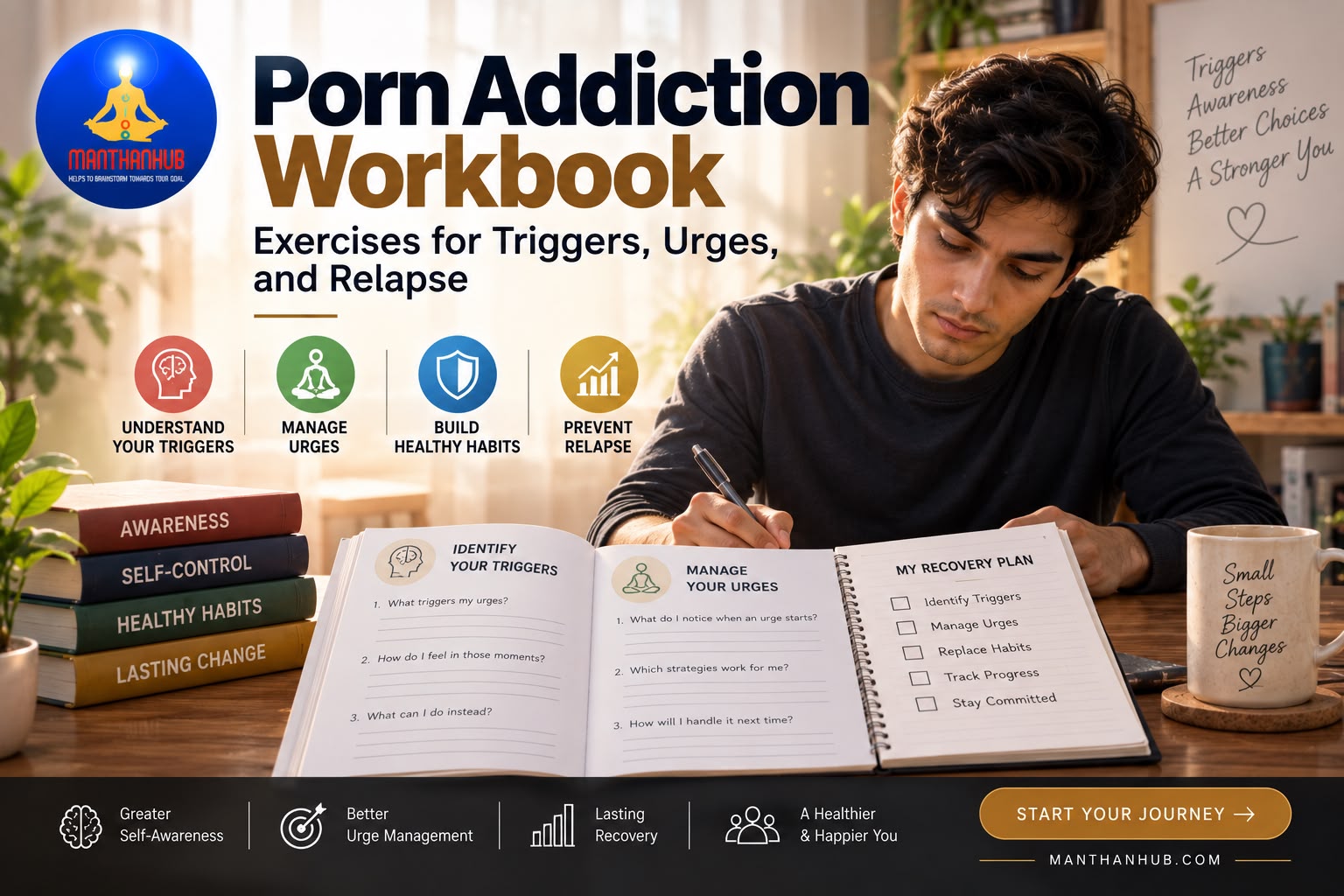
Learning about pornography addiction helps, but no one can recover unless what they have learned is translated into action. By providing you with effective exercises to identify triggers, cope with urges, learn about relapse, change routines, and develop healthier responses over time, a porn addiction workbook can help you get out of the motivational promises.
It is no secret that numerous individuals are ready to cease pornography. They are not struggling because they lack information. The issue is that they never looked closely at the processes that precede an urge, why some situations cause the relapse over and over again, and what components of their everyday environment complicate the recovery process.
The exercises in this workbook-style guide are designed to make those patterns visible. You may fill them out in a notebook, online journal, or printed recovery diary. Perfection is not the goal. The goal is to understand your behavior in a way that helps you develop a recovery system that is more specific, practical, and sustainable.
How to Use This Porn Addiction Workbook
A workbook is not like an ordinary article, since you are supposed to play an active role in writing down information about yourself.
Do not do all exercises at once. Some exercises take many days to build patterns of use. Preferably, you want to have a single recovery journal and break it down into four areas:
Triggers, Urges, Relapses, Recovery Actions
Go through your notes once per week. This helps you identify recurring patterns without judging yourself based on a single bad day.
Key Porn Addiction Workbook Exercises to identify Triggers, Urges, and Relapse
These exercises can also ensure you have a more productive session should you be following a structured PMO Recovery Program, as you come prepared with more informed knowledge of your behavior rather than just saying, “I relapsed again.”
Exercise 1: Build Your Personal Trigger Map
Create a Trigger Log
Whenever you experience a strong urge, record the following:
- Time: When did the urge happen?
- Location: Where were you?
- Emotion: What were you feeling?
- Device: Which device were you using?
- Previous activity: What were you doing during the previous 30 minutes?
- Intensity: Rate the urge from 1 to 10.
- Response: What did you do next?
Continue this exercise for at least seven days.
You may discover patterns such as strong urges appearing late at night, after arguments, during boredom, while scrolling Instagram, or when you are alone for long periods.
Once the pattern becomes visible, recovery becomes less mysterious.
Exercise 2: Find the Trigger Behind the Trigger
The visible trigger is not always the real problem.
You may write, “Instagram caused my urge,” but the deeper pattern could be boredom. Another person may blame nighttime phone use when the real trigger is loneliness or stress.
Use the following question repeatedly:
Why was I vulnerable at that moment?
For example:
I opened social media.
Why?
I was bored.
Why?
I had finished work and had no plan for the evening.
That reveals a more useful recovery target: unstructured evenings.
This deeper analysis is especially valuable for people using a Dopamine Discipline Program, because reducing high-stimulation behaviour is more effective when you understand why you repeatedly seek stimulation in the first place.
Exercise 3: Create Your Urge Emergency Plan
Strong urges are difficult moments for complicated decision-making. This is why you should create your response before the urge appears. Write down a simple five-step emergency plan.
For example:
Step 1: Put the phone down immediately.
Step 2: Leave the private room.
Step 3: Walk for ten minutes.
Step 4: Complete twenty push-ups or another physical activity.
Step 5: Begin a predetermined alternative task.
Your plan should be simple enough to follow even when motivation is low.
The purpose is not to magically eliminate the urge. It is to interrupt the automatic connection between an urge and pornography.
Exercise 4: Practice the 10-Minute Rule
When an urge appears, the mind often creates a sense of urgency. It may feel as though you need to act immediately.
Instead, delay the decision for ten minutes.
Write:
“I am not deciding anything for the next ten minutes.”
During those ten minutes, move away from the device and do something else. After ten minutes, reassess the urge.
If it remains strong, repeat the process. This exercise teaches an important principle: an urge can be uncomfortable without controlling your behavior.
People working with a structured Brain Rewiring Program can use this technique to repeatedly practice a different response to familiar cues.
Exercise 5: Identify Your High-Risk Hours
Most people do not have equal relapse risk throughout the day. Your risk may increase:
- After midnight
- Immediately after waking
- During weekends
- After work
- When staying alone
- After arguments
- During exam periods
- During travel
- While using the phone in bed
Review your trigger log and identify your three highest-risk periods. Then write one rule for each.
For example:
High-risk period: 11 PM to 1 AM
New rule: Keep your phone outside the bedroom after 10:30 PM.
High-risk period: Sunday afternoon
New rule: Gym or outdoor activity scheduled at 4 PM.
Recovery becomes easier when you design your environment around predictable weaknesses.
Exercise 6: Perform a Digital Environment Audit
A porn addiction workbook should examine not only explicit websites but also everything that leads toward them.
Open your phone and review:
- Your social media accounts
- Saved images
- Browser bookmarks
- Private folders
- Messaging groups
- Short-video feeds
- Search history
- Recommended content
Ask yourself:
Does this digital environment support recovery or continually test it?
Remove content that repeatedly triggers you. Unfollow accounts that create unnecessary sexual stimulation. Reset recommendation feeds where possible. Add website restrictions if they help create friction.
This exercise does not replace behavioral recovery, but it reduces unnecessary exposure.
Exercise 7: Build a Replacement Behaviour List
“Do not watch porn” is not a complete recovery plan. You also need to decide what you will do instead. Create three categories.
When I Am Bored
Write five activities such as:
- Reading
- Gym
- Walking
- Learning a skill
- Completing unfinished work
When I Am Stressed
Your alternatives might include:
- Breathing exercises
- Meditation
- Exercise
- Journaling
- Talking with someone
When I Feel Lonely
Possible responses include:
- Calling a friend
- Spending time with family
- Working from a public place
- Joining a group activity
- Seeking structured support
Someone who repeatedly struggles despite self-help exercises may benefit from one-to-one porn addiction recovery sessions, where personal triggers and recovery difficulties can be examined more closely.
Exercise 8: Complete a Relapse Autopsy
Study relapse, don’t simply regret it. Within 24 hours of a relapse, complete what we can call a relapse autopsy.
Write answers to these questions:
- What time did the relapse occur?
- Where were you?
- What emotion were you experiencing?
- What happened during the previous two hours?
- What was the first trigger?
- What was the first decision that moved you toward pornography?
- Which recovery boundary failed?
- What specific change will you make now?
For example, the final answer should not be:
“I need stronger willpower.”
Instead, it should look like:
“I will stop taking my phone into the bathroom because three of my previous relapses began there.”
That is actionable recovery. Structured approaches such as the Breaking Chains Program can naturally connect with this stage because repeated relapse often requires examining the entire chain of behavior rather than only the final event.
Exercise 9: Separate a Slip From a Full Relapse Cycle
One mistake can quickly become multiple days of pornography use because of all-or-nothing thinking.
A person may think:
- “I already failed, so my streak is gone anyway.”
Write this recovery rule somewhere visible:
One mistake does not require a second mistake.
After a setback, immediately complete three actions:
- Remove the immediate trigger.
- Record what happened.
- Return to your normal recovery routine.
Do not wait for tomorrow, Monday, next month, or another perfect starting date.
The speed at which you return to healthy behaviour matters.
Exercise 10: Track Progress Beyond Streaks
Streaks can be motivating, but they don’t fully capture recovery. Create a weekly scorecard using these categories:
- Trigger awareness: /10
- Urge management: /10
- Digital discipline: /10
- Sleep routine: /10
- Exercise: /10
- Emotional regulation: /10
- Productive work: /10
- Social connection: /10
This gives you a broader view of recovery. Someone may relapse once during a month while dramatically improving sleep, exercise, trigger awareness, and emotional control. That is different from making no behavioral progress at all.
Programs such as Neuro-Monk One-on-One Healing can be naturally linked from discussions about emotional patterns, self-awareness, and deeper personal work, rather than forcing the keyword into unrelated paragraphs.
Exercise 11: Create Your Porn-Free Identity Statement
Recovery should eventually become larger than avoiding pornography.
Ask yourself:
Who am I becoming?
Then complete these sentences:
- I want to become someone who ______.
- My health matters because ______.
- My relationships matter because ______.
- My career or studies matter because ______.
- My biggest reason for recovery is ______.
- The strongest version of myself would spend evenings ______.
- This exercise shifts attention from deprivation toward identity.
Instead of thinking only:
“I cannot watch pornography.”
you begin thinking:
“I am building a life where this behaviour no longer fits.”
That broader identity-building approach can naturally connect readers with the Superhuman Lifestyle Program, which focuses on discipline, intentional living, and self-mastery beyond a single habit.
Exercise 12: Build Your 30-Day Recovery System
Now combine everything you have learned. Create four weekly priorities.
Week 1: Remove Obvious Triggers
Clean your devices, change high-risk routines, and begin tracking urges.
Week 2: Strengthen Replacement Habits
Add consistent exercise, productive activities, better sleep, and meaningful social interaction.
Week 3: Study Emotional Patterns
Pay particular attention to stress, loneliness, rejection, frustration, and boredom.
Week 4: Build Long-Term Identity
Shift your attention toward relationships, work, health, purpose, and personal growth.
For people who want broader personal transformation after stabilizing compulsive behaviour, internal links to the Avatar Super Program or Mrityunjaya Program can be positioned here because these services represent a wider transformation stage rather than immediate urge control.
Conclusion
A porn addiction workbook is most useful when it forces you to stop thinking about recovery in vague terms.
Instead of saying:
“I need more discipline,” you identify exactly when you lose discipline.
Instead of saying: “I have too many urges,”
you discover what triggers those urges.
Instead of saying: “I always relapse,”
you study the sequence of decisions that happens before each relapse.
Recovery becomes easier when the problem becomes specific.
Use the exercises in this workbook to map your triggers, prepare for urges, change your digital environment, study relapses, track real behavioral progress, and develop an identity that extends beyond simply maintaining a streak.
ManthanHub’s recovery books, courses, and personal guidance can provide additional structure for individuals who want to move from repeatedly restarting recovery toward building a consistent system.
The goal is not to become someone who spends every day fighting pornography. The goal is to build habits, routines, relationships, and a meaningful life in which the old pattern gradually loses its importance.
FAQs
What is a porn addiction workbook?
A porn addiction workbook is a practical recovery resource containing exercises designed to help individuals identify triggers, understand urges, analyze relapse patterns, change routines, and track behavioral progress.
How should I track porn addiction triggers?
Record the time, location, emotion, device, previous activity, urge intensity, and your response whenever a major urge appears. Reviewing several entries can reveal recurring patterns.
What should I write after a porn relapse?
Document the trigger, emotional state, environment, events preceding the relapse, the first decision that moved you toward pornography, and one specific change you will make to prevent the same pattern.
Can a workbook help prevent porn relapse?
A workbook can improve awareness and planning, but results depend on consistently applying what you learn. Some individuals may also benefit from structured coaching or qualified mental health support.
Should I track only the number of porn-free days?
No. Track trigger awareness, urge management, digital discipline, sleep, exercise, emotional regulation, productivity, and relationships, too. These provide a broader picture of behavioral recovery.