


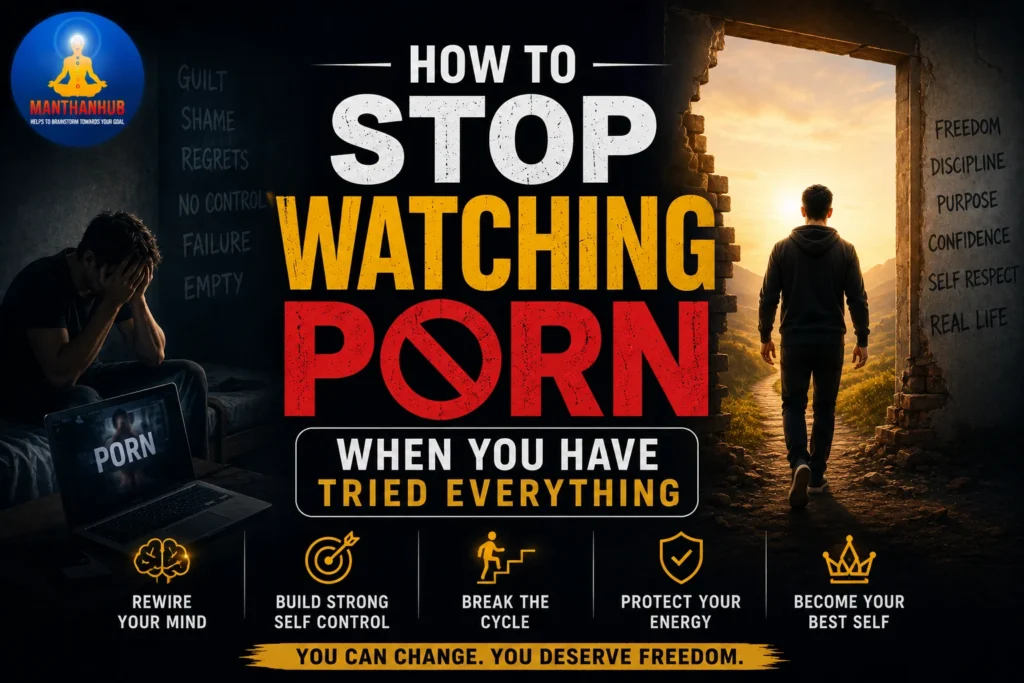
You delete everything. It was the last time you promised yourself. You go away for a few days, or weeks, and then after a single tense or desolate night, you are launched into precisely the same orbit again. If you are searching for how to stop watching porn after trying blockers, motivation, NoFap challenges, strict routines, and repeated promises, the problem may not be that you have not tried hard enough. What you might actually be struggling with is the behavior, not the pattern, that is taking you back and bringing you back again.
Repeated pornography may be associated with stimuli, feelings, habits, simple online access, and conditioned reactions to distress. That is to say that long-term change often demands more than the force of will. Here you will explore how to stop watching porn, what initiates the cycle, make pornography more difficult to get, come up with other ways to work with impulses, and create a lifestyle that does not systematically propel you towards the same behavior.
Why Is It So Difficult to Stop Watching Porn?
Know what is maintaining the behavior before you seek an alternative. Individuals tend to debate pornography as an independent issue when it might have become associated with boredom, stress, loneliness, sexual arousal, procrastination, sleeping habits, or avoidance.
Being able to identify these patterns is a key step in learning how to stop watching porn because you cannot alter a cycle that you never studied.
Porn Can Become an Automatic Habit
Reinforced behaviors get linked with cues. When you watch pornography and are home alone at night, or after you have a habit of watching these kinds of videos alone, being home with your phone alone at night will one day even become a part of the habit pattern.
The behavior may start before you consciously decide what to do.
Porn May Become an Emotional Escape
For some people, pornography is not only about sexual stimulation. It becomes something they resort to anytime they are stressed, lonely, rejected, frustrated, bored, or overwhelmed.
When you take away pornography and you have never developed healthier methods of coping with such feelings, the initial provocative factor remains.
Easy Digital Access Makes Relapse Easier
An array of material is accessible instantly through a smartphone. Social media may also expose you to content that initiates a process of curiosity to search and ultimately to pornography.
When self-control is the only type of control needed, it becomes even harder because the behavior is always available.
Shame Can Keep the Cycle Going
The relapse can result in self-blame, extreme self-criticism, and self-persecution, like, “I have ruined everything anyway.” This attitude can turn a single occurrence into frequent use.
Answering to someone is one thing; punishing them is another. When you have a setback, the useful question is what went wrong and what should be different.
Why Everything You Tried May Have Failed
Many widely known techniques are useful, but they tend to be ineffective when treated as full-scale recovery plans. Website blockers, streaks, motivational videos, and challenges are some of the solutions to the pieces of the problem. They don’t necessarily change the overall pattern of behavior.
Have you kept on searching for how to stop watching porn? Look at whether this is one of the mistakes holding you back.
You Were Depending on Willpower
When you are relaxed and in the mood, it becomes easy. It is unfortunate that most of the time urges seem to come at a time when you are weary, agitated, angry, or alone.
The conditions that require extraordinary strength of will should be minimized with the help of the recovery system.
You Focused Only on Your Streak
A thirty- or ninety-day porn-free streak is significant. But a streak merely informs you of how long you had been avoiding a behavior, not of whether you dealt with the causes of the behavior.
When the same trigger and environment remain, and coping mechanisms haven’t changed, reaching a milestone doesn’t guarantee permanent recovery.
You Removed Porn but Kept the Triggers
Deleting content you previously filled your feed with, following accounts that trigger content suggestions, or spending ad hoc time alone on the Internet can open the door to pornographic material. Management of triggers should start long before pornography is shown on the screen.
You Tried to Suppress Every Sexual Thought
Repeating what was already done, but more intensely, may not be helpful. Modify the surroundings of the behavior. An effective recovery system ought to consider access, triggers, emotional regulation, replacement habits, accountability, and relapse prevention.
How to Stop Watching Porn: Build a System That Works
If previous attempts have failed, do not simply repeat them with greater intensity. Change the structure around the behavior. A practical recovery system should address access, triggers, emotional regulation, replacement habits, accountability, and relapse prevention together.
Identify Your Personal Porn Triggers
For one or two weeks, record what happens before strong urges or pornography use.
Look for patterns involving:
- Time of day
- Location
- Device being used
- Social media
- Boredom
- Stress
- Loneliness
- Conflict or rejection
- Poor sleep
- Alcohol or other situations that reduce inhibition
Once your porn addiction triggers become visible, you can create specific responses for them instead of relying on vague determination.
Make Access Deliberately Difficult
Install content restrictions or website blockers, remove saved material, unfollow triggering accounts, disable private browsing where possible, and avoid taking your phone into situations where you commonly relapse.
No blocker is perfect. That is not the point. Adding friction creates time between an urge and an action, giving you another opportunity to make a different decision.
Build an Emergency Plan for Strong Urges
Do not design your strategy while you are already overwhelmed by an urge.
Create a predefined response:
Urge appears → leave the private environment → put the device away → move physically → contact someone if needed → begin a predetermined alternative activity.
Knowing how to stop porn urges is partly about reducing the time available for negotiation with yourself.
Replace the Behavior Instead of Leaving a Vacuum
Getting rid of an engaging habit leaves open space. When you don’t organize that time, the old behavior can easily return. Healthier uses of that space include exercise, reading, outdoor activity, focused work, learning, hobbies, meditation, and meaningful social interaction.
Replace it with the trigger. When loneliness drives the behavior, an alternative solitary activity may not address the problem. Human connection may be more helpful.
Stop Treating Dopamine as the Entire Explanation
The content of online pornography recovery often simplifies the issue to dopamine addiction. That is too simplistic an explanation.
Dopamine is involved in motivation, learning, reward prediction, and many other normal performance activities in humans. You do not have to stop dopamine; there is no scientifically determined switch that turns the dopamine system of all people off after 30 or 90 days.
It’s about ridding ourselves of compulsive behavior and overstimulation and finding healthier forms of reward.
Reduce Unnecessary Digital Stimulation
Still, as long as you give up on porn but spend six hours flipping back and forth between reels, short videos, and cyberplay, as well as limitless feeds, then you are arguably sustaining a life of constant stimulation.
Making screen-free times may enhance your tolerance to boredom and help you focus on more engaged, intentional things.
Learn to Delay Gratification
Do honest toil and then go to sport. Work out at a time that you would prefer to be relaxed. Complete important assignments without constant phone checks.
These normal decisions reinforce greater behavioral discipline that aids in recovery.
What to Do When an Urge Suddenly Hits
Understanding how to stop watching porn intellectually is different from managing a strong urge in real time. Your immediate objective is not to argue with the urge for an hour. It is to create distance from the situation that makes acting on it easy.
Change Your Environment Immediately
Stand up and leave the room. Move into a shared space, go outside, or place yourself somewhere pornography is not realistically accessible.
Changing context can interrupt an automatic sequence before it progresses further.
Delay Instead of Debating
Tell yourself you will not act for the next ten minutes. During that period, walk, exercise, shower, breathe slowly, or complete another activity.
An urge can change in intensity. You don’t have to obey it just because it feels urgent.
Observe What the Urge Is Actually Asking For
Ask whether you are genuinely sexually aroused or whether you are bored, lonely, anxious, stressed, frustrated, or trying to avoid another task.
Understanding the underlying need gives you a better chance of choosing an appropriate response.
What Should You Do After a Porn Relapse?
A porn addiction relapse should neither be catastrophized nor ignored. If you repeatedly relapse, something in your current recovery strategy is failing and needs adjustment.
Do a short relapse review within 24 hours:
What triggered me? Where was I? What was I feeling? What happened during the previous hour? Which boundary failed? What will I change before this situation happens again?
This turns relapse into usable information.
Avoid the “I already failed, so it doesn’t matter anymore” mentality. One episode does not require another. Return to your recovery plan immediately.
Conclusion
Another promise to yourself is probably not what you need if you have already tried everything and still cannot figure out how to stop watching porn. Determine precursors to the urge. Remove unnecessary triggers. Increase restrictions on gaining access to pornography. Prepare an emergency response in serious times. Substitute the behavior with something important.
Tackle the feelings that continually lead you towards pornography. And when a relapse occurs, do some research into it rather than make it yet another week of compulsive behavior.
ManthanHub can facilitate the process with PMO recovery books by Radheshyam More, planned recovery programs, the brain-rewiring method, and individual guidance.
It is not about fighting against pornography on a daily basis. This aims to create a life, world, and routine where pornography loses its place, particularly over time.
FAQs
How can I stop watching porn permanently?
No single technique guarantees permanent recovery. Identifying triggers, restricting access, changing routines, developing healthier coping strategies, and seeking appropriate support can make long-term change more achievable.
Why do I keep watching porn even when I want to stop?
Repeated use can become associated with particular emotions, environments, devices, and routines. Understanding these triggers is often more useful than assuming the problem is simply weak willpower.
How do I control porn urges at night?
Keep devices away from your bed, establish a fixed sleep routine, reduce late-night scrolling, and leave the private environment when a strong urge develops.
Does a porn relapse mean I have failed?
No. But it should be taken seriously. Identify the trigger and sequence that led to the relapse, change the weak point in your recovery plan, and return to healthier behavior immediately.
When should I get professional help for pornography use?
Consider professional support when pornography feels uncontrollable or repeatedly causes significant problems in relationships, work, studies, sexual functioning, or emotional well-being.