


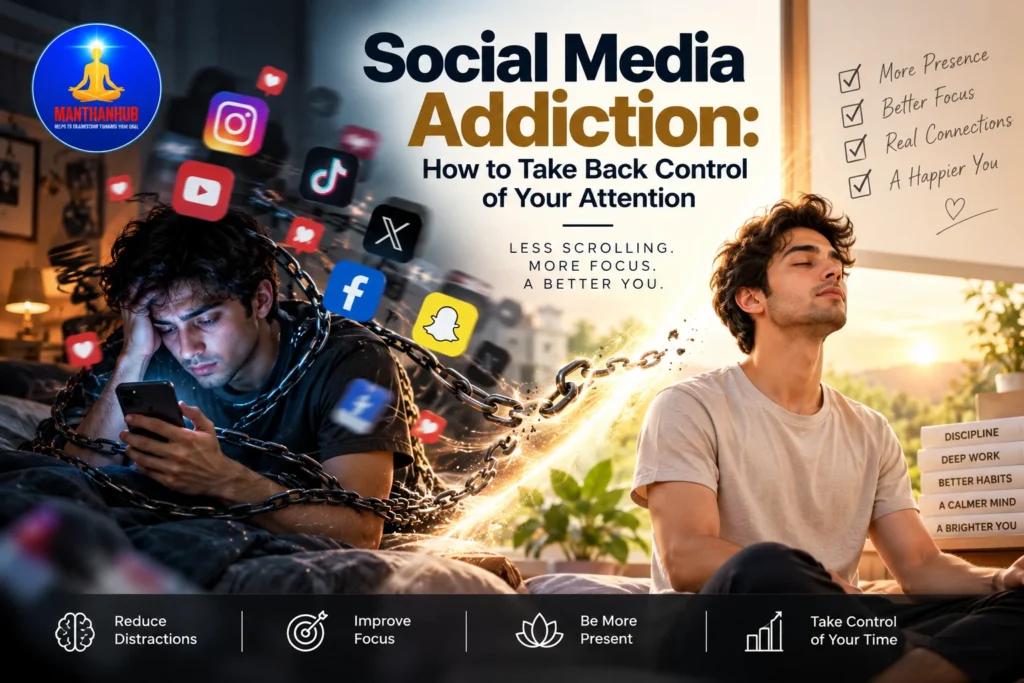
Social media is meant to keep you connected, updated, and entertained. But when you open one notification, scroll for an hour, and watch short videos, your concentration suffers; you feel stressed when your phone vanishes, and you realise it’s no longer leisure.
It might gradually become a social media addiction, taking away your everyday habits, focus, and sleep as social media takes over your schedules, mental capacities and sleep patterns.
The best thing is that you have an opportunity to regain control. You don’t need to delete every app at night or go completely offline.
Healing involves identifying your triggers, understanding your compulsive cycles, restoring focus, and building stronger digital boundaries. Digital well-being means choosing to use technology over algorithms/Warnings and deciding what to pay attention to.
What Is Social Media Addiction?
Social media addiction refers to tendencies to use social media in excessive amounts and develops into a habit of acting where it becomes hard to stop and starts to disrupt attention, sleep, relationships or the spirit of work.
Not everyone who uses social media regularly is addicted. The real problem sets in when the behaviour becomes automatic, hard to stop, or repeats no matter how negative the consequences.
Social Media Addiction Symptoms to Watch
Such typical symptoms of social media addiction may be checking apps as soon as you wake up, feeling anxious without your phone, wasting time scrolling, having lower concentration, insomnia, procrastinating, or being compelled to tap on social sites without any apparent justification.
Some also notice that ordinary tasks (reading, studying, or working) are no longer as interesting as fast-moving feeds and short content.
Why the Habit Feels So Automatic
Notifications, infinite scroll, suggestions, and dynamically shifting content on social media platforms keep us engaged.
Over time, the habit of checking may be tied to boredom, stress, loneliness, or even small moments of discomfort. That is why simply telling yourself to use your phone less is usually not effective.
How Social Media Affects Your Attention
Fragmented attention is one of the most apparent socially mediated impacts of social media on the brain. This constant switching between videos, messages, notifications, and feeds conditions you to seek quick stimulation.
Social media is not fully or permanently brain-destroying. The issue is that habitual digital practices can make it harder to sustain attention.
Short-Form Content Trains Fast Switching
When you don’t get time to calm down because your brain is accustomed to switching content every few seconds, patient activities can start to feel oddly slow. This can take a toll on reading, studying, deep work and even conversation.
Doomscrolling Keeps the Mind in a Reactive State
Doomscrolling is the habit of repeatedly reading or viewing negative or emotionally charged material even though you know it is hurting you. This behaviour can keep your focus in a reactive loop, leading you to another post and making you lose track of time.
Brain Rot Can Feel Like Mental Overload
The phrase “brain rot” has become a popular online concept to describe the mental fog, lack of concentration, and overstimulation some people experience from watching too much low-value digital content.
It is not a diagnosis, but the experience can be very real on days when you feel that you scroll and do not think much at all.
Why Social Media Addiction Is So Hard to Stop
It becomes hard to quit social media addiction since this is a behaviour that is embedded in normal life. You can communicate, work, entertain, access news and socialize with the same apps.
This suggests that total elimination isn’t necessarily the goal. The goal is to learn to distinguish between useful use and compulsive use.
Boredom Becomes a Trigger
When they have nothing to do, many reach for their cell phones. Through the time, scrolling as such is triggered by boredom.
In case you are aiming at long-term recovery with digital addiction, you should develop the capacity to sit down and boredom without having the need to stimulate yourself.
Stress Creates Escape Behaviour
Social media may easily turn into an immediate relief of work pressure, emotional stress, or anxiety.
The thing is that the relief is temporary. The initial stress is still present and the habit gets stronger.
Notifications Keep Restarting the Loop
Each notification is another chance to relaunch the app. One notification is enough to distract you out of the feed, even when you intentionally wanted to concentrate.
How to Stop Social Media Addiction
There is no need to learn how to quit social media addiction by getting anti-technological. It’s about re-establishing control over when, why, and how you use it.
The practices below are more applicable when used together and should not be applied separately as tricks.
1. Track Your Real Screen Time
Start by assessing how much time you spend on social media each day. Most people undervalue their usage.
Write down:
- How much time you spend in front of a screen each day.
- Most-used apps
- When used the most.
- What feeling does scrolling normally precede?
This awareness gives you a clearer starting point.
2. Remove Unnecessary Notifications
Switch off alerts that do not need urgent attention. This easy trick will decrease automatic checking and save your concentration against frequent distractions.
3. Create Social Media Windows
Instead of browsing apps all day, choose specific times. For example, allow 20 minutes during lunch and 20 minutes in the evening. This transforms social media to a deliberate behaviour instead of an automatic one.
4. Keep Your Phone Away During Deep Work
When your phone is nearby, you can be more distracted. To recover your attention span, put it in a different room or use a focus mode when working, studying, reading, or having important conversations.
5. Stop Scrolling Before Sleep
Scrolling late may postpone sleep and stimulate the mind. Make a simple guideline like not using social media 45-60 minutes before sleep. This helps digital well and more healthy sleep.
Try a Social Media Detox Without Going Extreme
A social media detox does not require assuming that you delete all accounts. An effective detox may include exposure reduction, uninstalling the most addictive apps, or taking breaks.
Start With a 24-Hour Reset
Select a day on which you do not use non-essential social media. Observation: Pay attention to how often you automatically grab your phone. This will help you see how much the habit is tied to boredom, stress, or routine.
Remove Your Most Triggering App First
You need not erase everything. Begin with the platform that takes the longest time or gives the strongest incentive to continue scrolling.
Replace Scrolling With a Real Activity
A social media detox is more efficient when you use the free time. Try walking, reading, exercising, journaling, and meeting with people in person. Unlearning the behaviour without replacing it usually leaves a vacuum that draws you back in.
Rewire Your Attention Instead of Just Fighting the Habit
Long-term change cannot only be restricted. It needs rewiring of habits. The aim is to teach yourself that boredom, stress, or free time doesn’t necessarily mean you have to scroll.
Build New Attention Patterns
Begin with brief spurts of concentrated effort. Twenty minutes of uninterrupted reading or deep work can prove to be a strong start. Progressively extend these sessions.
Practise Delayed Gratification
Perform a challenging task prior to opening social media. Exercise before entertainment. Complete the work block and then check your feed. It is these little choices that create self discipline.
Make Your Environment Support Focus
Move distractions apps out of the home screen. Use grayscale mode. have your phone outside your bedroom. An improved environment also lessens the times when you have to use willpower.
How ManthanHub Supports Digital Habit Recovery
ManthanHub tackles compulsive online behaviour via systematic behaviour change, brain reconstruction, self-discipline, and attention management.
Dopamine Discipline Program
The Dopamine Discipline Program will be aimed at individuals that have issues with immediate satisfaction, digital excess, impulsive behavior, and poor concentration.
It is useful in linking daily digital behaviour to discipline and healthier rewarding behaviour.
Brain Rewire Sessions
The offerings of Brain Rewire Sessions can help those who wish to practice attention, repetition, emotional triggers, environment, identity, and practices change in a more organized manner.
ManthanHub Brain Rewire
A structure exists in ManthanHub Brain Rewire by Radheshyam More that goes by the name Attention, Repetition, Emotion, Energy, Environment, Identity, and Purpose.
These seven aspects should assist readers to transform digital recovery into larger lifestyle change, should they find it necessary to get back on track.
One-to-One Mentorship
Individual responsibility concerning discipline, routines, and online routines and consistency Where a personalised accountability with regard to discipline, routines, and online routines is needed, it can be achieved through One-to-One Mentorship.
Social Media Addiction and Broader Digital Recovery
The addiction to social media of certain people is only one part of a larger digital addiction that encompasses the zones of game playing, content of short videos, scrolling endlessly or checking the phones.
In this case, digital addiction recovery is more convenient and can be achieved through a more specific application.
It is not merely aimed at reducing Instagram or YouTube. It aims to build a healthier relationship with stimulation, attention, and technology in general.
Conclusion
There is no single dramatic decision that often initiates social media addiction. It expands with a series of little habits: checking notifications, scrolling during boredom, and using feeds to forget about stress, and swapping attention all the time.
Regaining control involves the same repetition. Track your triggers. Reduce notifications. Create social media windows. Guard thy deep work. Get better sleep habits. Practise delayed gratification. Build stronger habits.
The answer is a brief social media detox; it will reestablish your relationship with technology, though long-term recovery comes only from changing the system that underlies the behaviour.
The Dopamine Discipline Program, Brain Rewire sessions, ManthanHub Brain Rewire, and One-to-One Mentorship can help individuals follow a more systematic route to better focus, improved digital well-being, and long-term self-control.
It does not mean to drop your phone. The idea is to ensure your phone doesn’t control you anymore.
FAQs
What are the common social media addiction symptoms?
Some of the most typical symptoms of social media addiction are the compulsive checking, losing the sense of time, lack of concentration, sleep disturbances, procrastination, and even feeling agitation when you are not connected online.
Will a social media detox be of help?
A social media detox may help you become more conscious, less addicted to checking, and make room in your day for something healthier. You still need to change habits and your environment to improve in the long term.
What is the recovery time of attention span?
It doesn’t follow a strict schedule. Recovery of attention span relies on screen using habits, sleep, stress and adherence to focused actions.