


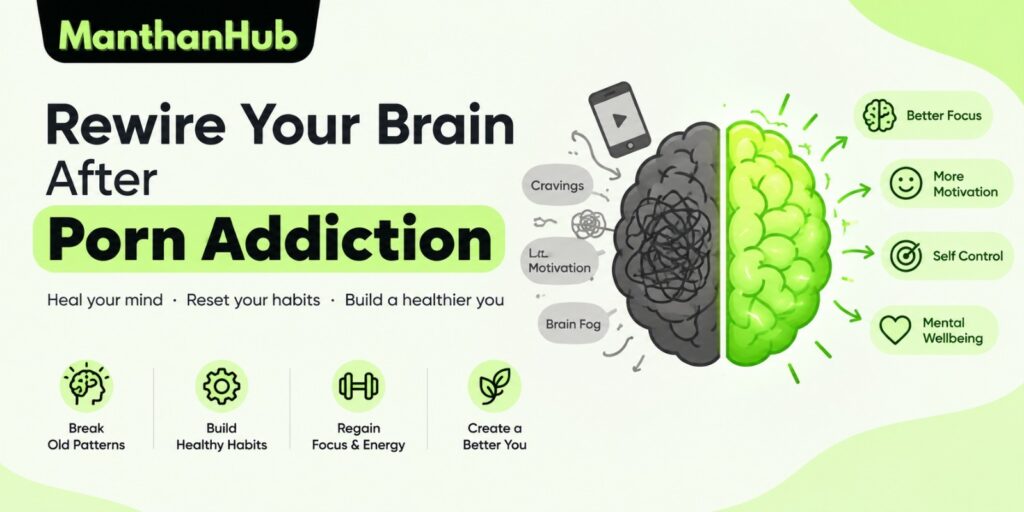
Is it possible to rewire your brain after Porn addiction? The brief response is that the brain can indeed change over the course of life and experiences, repeated behaviours, learning and environments can shape the functioning of the neural pathways.
The fact that behavioural change can occur after a long history of addictive or compulsive behaviour is in part due to this ability, which is referred to as neuroplasticity.
Nonetheless, brain wiring is not some sort of magic rewind that occurs after a predetermined amount of days. Recovery is a process where new behaviours are practised again and again, where environmental prompts are replaced, triggers are handled, healthier coping strategies are developed and routines that facilitate long-term change are established.
This may render neuroplasticity in addiction recovery an essential concept to grasp for people labouring through pornography or obsessive behaviour concerning PMO. This is not to forget but rather to create better patterns for the future.
What Does It Mean to rewire your brain after Porn addiction?
“rewire your brain after Porn addiction” is a phrase widely used to refer to the procedure of altering the patterns of learned behaviour. It cannot be taken figuratively, i.e., as literally displacing or erasing certain brain circuits.
Through repeated behaviours, the brain learns relationships among cues, expectations, behaviour, and results. The only way to change that behaviour is to keep creating the opportunity to react differently.
Repetition Helps Build New Patterns
Imagine that an individual is constantly using pornography to deal with stress. stress is conditioned as a conditioning stimulus, pornography is the conditioned response, and temporary relief is a positive reinforcement of the habit.
There is another response to recovery. The individual becomes aware of the stress, notices the urge, modifies the environment, engages in physical activity, talks to someone, writes in a journal, or uses a healthier coping mechanism. Regular repetition of that alternative response will make it familiar.
Recovery Is Not About Erasing Memories
You need not forget pornography and all your sexual thoughts to get better. This aims to break the automatic link between a trigger and compulsive behaviour and to help you gain more control over your reaction.
That differentiation is significant, as making people anticipate that the brain is likely to forget about an addiction may lead to unrealistic expectations and unwarranted frustration.
How Does Neuroplasticity Support Addiction Recovery?
Neuroplasticity to rewire your brain after Porn addiction is founded on the brain’s ability to evolve as a result of experience and rehearsal behaviour.
This is evidenced in everyday learning. Practice makes skills familiar, and repeated behaviours can get more automatic. Recovery puts the same general principle into practice in yet another direction: at least to the extent of being more regular, practice the healthier responses.
Old Habits Can Become Less Dominant
Even when you stop doing something, the old behaviour might be so familiar it is still with you.
The desire can be triggered even months later. It does not necessarily mean recovery is unsuccessful. It implies that the old association can still be available.
Rather than reinforcing the old pattern, repeating a new response creates new experiences that reinforce behavioural change.
New Behaviours Need Repetition
A single chemical reaction to an urge is not enough. Hundreds of consistent responses can be much more meaningful. This is the reason why addiction rewiring of the brain should not be based on a quick fix but repetitive practice.
Working out one time will not change your lifestyle. Stress will not disappear in one meditation session. A successful urge-management method will not necessarily guarantee permanent recovery.
What Happens During Brain Rewiring for Porn Addiction?
If you are looking to rewire your brain after Porn addiction, recovery may include altering multiple behaviours related to it, instead of concentrating on the issue of porn itself.
Pornography can be linked to a specific time, place, gadget, feeling, or habits. You can incorporate all of these into your recovery.
Recognize the Trigger Before the Urge Escalates
The earlier you identify a trigger, the more choices you have. Instead of waiting until an urge becomes overwhelming, notice the sequence:
Trigger → thought → anticipation → urge → behaviour
Then introduce a different response as early as possible.
Change the Environment
In case your phone, bed, social media feed, or late-night ritual habitually leads to consuming pornography, you can alter your setting and minimize exposure to the previously stocked signals.
Separate your phone with your bed. Remove triggering accounts. Use appropriate content restrictions. Avoid unjustified end-of-day scrolling.
These developments do not indicate a lack of strength. During the process of establishing new habit, they decrease chances of automatic behaviour.
Practice a Replacement Behaviour
Replacement behaviour provides an alternative activity for what your brain would have done when the familiar pattern started. This may be exercise, walking, focused work, reading, social interaction, meditation, or leaving the environment where the urge formed, depending on the circumstances. The new solution must be practical and reproducible.
How PMO Recovery Relates to Brain Rewiring
Stopping pornography may not be the only recovery that can be promoted by PMO. PMO tends to refer to pornography, masturbation and orgasm and individuals could have various schemes and objectives related to those activities.
To a person who has learned to adopt a compulsive PMO cycle, rewiring the brain can be done by looking at what it is that is motivating the behaviour.
Identify the Complete Behavioural Loop
Rather, look at what occurs in anticipation of the ultimate act.Was there boredom? Stress? Loneliness? Social media sexual stimulation? Procrastination? A late-night routine? Emotional discomfort?
It can be quite easier to discover the onset of the cycle and intervene.
Build New Responses to Emotional Triggers
When PMO turned into a form of escapism, merely getting rid of pornography might leave the problem still unresolved.
Learning to better cope emotionally can be the part of recovery, then.
To enable individuals that prefer formal guidance, a PMO Recovery Program can offer a guide in analyzing these patterns and constructing viable recovery practices.
Why Relapse Prevention Is Part of Brain Rewiring
A strong recovery strategy cannot focus only on successful days. It must also prepare for difficult days.
Relapse prevention involves identifying high-risk situations, recognizing warning signs, preparing alternative responses, and learning from setbacks.
Identify High-Risk Situations
Your personal risk factors may include:
- Staying awake alone late at night
- Stressful work periods
- Loneliness
- Relationship conflict
- Excessive social media use
- Boredom
- Unstructured weekends
- Exposure to triggering content
- Poor sleep
- Emotional distress
Once you identify these situations, you can prepare for them instead of improvising when an urge appears.
Use a Relapse as Information
A relapse does not erase every positive change you made. Instead, examine what happened before it.
What was the trigger? What decision came immediately before the behaviour? Which boundary disappeared? What could be changed next time?
This approach transforms relapse from a reason to abandon recovery into information that can strengthen your strategy.
Can You Rewire Your Brain Without Professional Support?
People can effectively change problem behaviours through self-planned approaches, education, responsibility, and lifestyle changes. Others struggle even with earnest attempts.
No universal recovery plan works for everyone. Professional mental health support is potentially necessary if compulsive pornography or sexual behaviour is leading to severe issues in your relationships, work, studies, sexual functioning or emotional well-being.
Guided programs may offer more accountability for people who want guided personal-development support in PMO recovery, habit change, self-control, and behavioural change.
Private PMO Recovery Sessions
PMO Recovery Sessions are more private and offer a more personalised space to discuss personal triggers, habits, obstacles, and recovery goals.
One-to-one advice can be effective when a person does not want to share all their problems in a group and doesn’t want to be guided in a group.
One-to-One Mentorship
One-to-One Mentorship may be used as a means of continued organisation and support as one undergoes behavioural changes.
Rather than receiving general guidance, the person can review their progress, identify recurring challenges, and consider practical tweaks to their recovery process.
How to Support Brain Rewiring Every Day
If you want to rewire your brain after Porn addiction, focus less on dramatic interventions and more on repeated daily behaviours.
Exercise Regularly
Physical activity can replace periods previously associated with compulsive behaviour. It can also provide structure and a constructive way to manage everyday stress.
Improve Your Sleep Routine
Late-night isolation and unrestricted phone access can become powerful triggers for some people. A consistent sleep schedule and a technology boundary around bedtime can reduce unnecessary exposure.
Practice Focused Work
Train yourself to stay with meaningful tasks instead of constantly switching between notifications, social media, and short-form content.
Improving attention in ordinary life supports the broader goal of becoming less reactive to immediate stimulation.
Build Meaningful Social Connection
Isolation can increase vulnerability for some individuals. Spending time with trusted friends, family, colleagues, communities, or other supportive people can provide healthier connections.
Create a Purpose Beyond Recovery
Recovery should eventually become one part of your life, not your entire identity.
Career goals, relationships, fitness, creativity, learning, spirituality, service, or personal projects can give you reasons to keep building healthier patterns.
Conclusion
If you want to rewire your brain after Porn addiction, the journey requires more than simply waiting for a reset. At ManthanHub, we approach recovery through awareness, practical habit change, trigger management, self-control, and consistent behavioural practice.
Whether you are struggling with pornography, PMO patterns, compulsive habits, or repeated relapse, the right structure can help you understand the cycle and build healthier responses.
Through the PMO Recovery Program, Private PMO Recovery Sessions, and One-to-One Mentorship, ManthanHub provides focused support for individuals ready to work on lasting behavioural change.
Neuroplasticity creates the possibility for change, but your daily actions create the momentum. You do not have to keep repeating the same cycle. Start understanding your patterns, rebuilding your habits, and creating a more disciplined life.